Most Deliveries Are Forgettable
Ask someone to tell you about a delivery they remember, and chances are it will not be the one that arrived exactly when it should have, in good condition, with the right paperwork and no fuss.
It will be the one that turned up late, arrived damaged or somehow could not be found. The one that caused a customer to chase, a warehouse team to reshuffle their day, or a sales team to have an awkward conversation they could have done without.
That is the strange thing about logistics. When pallet deliveries, groupage freight or full load transport go well, they often disappear quietly into the working day. Nobody talks about them in a meeting. Nobody sends a dramatic email. Nobody has to stop what they are doing to ask where the freight has gone.
And in many ways, that is exactly the point.
Because in logistics, forgettable is not failure. Often, it is the highest compliment.
A good delivery lets everyone get on with their day
A successful delivery does not always need to feel impressive; most of the time, it simply needs to work.
The freight needs to be collected when expected. It needs to be handled properly, routed correctly and delivered to the right place, at the right time, in the right condition. The customer needs to know what is happening. The recipient needs to be able to receive it without confusion. And if something changes along the way, somebody needs to spot it early enough to do something useful about it.
That might not sound exciting, but it matters.
For manufacturers, a missed delivery can hold up production. For retailers, it can mean empty shelves or disappointed customers. For ecommerce businesses, it can affect reviews, repeat orders and customer confidence. For construction suppliers, it can delay work on site and cause problems that spread quickly through a project.
So no, an ordinary delivery is not really ordinary at all. It is part of a much bigger chain of events. It just works best when the customer does not have to think about it too much.
The easier it looks, the more work is usually happening behind the scenes
From the outside, a delivery can look simple: a pallet leaves one place and arrives at another. But anyone who works in transport knows there is far more to it than that.
Before a delivery becomes forgettable for the customer, plenty of people have already paid attention to it. The booking needs to be right, the freight properly labelled and the collection fitted into the route. The warehouse team has to handle it carefully, while the vehicle needs to be loaded in a way that makes sense for the run. The driver needs the right information, the customer needs visibility, and proof of delivery needs to be captured clearly.
None of these things are especially glamorous, but together they can be the difference between a smooth delivery and a problem that takes up half a morning.
That is why visibility has become such an important part of modern logistics. Customers do not want to chase every consignment. They want to know that their freight is moving, that someone has control of it, and that they can get the information they need without waiting for three phone calls.
At Browns, customers can use our real-time consignment tracking to follow pallet deliveries from collection through to delivery, with updates, proof of delivery and digital records available when they need them.
Because good logistics is not just about moving freight. It is about giving people confidence while it moves.
The customer should not have to become the transport expert
One of the biggest changes in logistics over the last decade is expectation.
People are now used to visibility in almost every part of life. They can track a takeaway, a taxi, a parcel, a supermarket order and a flight. So, when it comes to palletised freight, warehousing, fulfilment or business deliveries, patience for uncertainty is much lower than it used to be.
That does not mean every customer expects miracles. Most people understand that transport involves moving parts. Roads close, sites get busy, weather changes and vehicles get delayed. Delivery points are not always ready, and freight sometimes arrives later into the pallet network than planned.
But customers do expect clear information. They want to know whether their freight has been collected, whether it is on schedule, whether there is a problem and, if there is, whether somebody is sorting it. Most importantly, they want to feel like they are not being left to figure it out themselves.
That is where the human side of logistics still matters.
Systems can show where something is. People decide what to do next.
People stop small issues becoming big ones
There is a lot of talk in logistics about technology, and rightly so. Good systems make transport more visible, more efficient and easier to manage.
But technology does not replace judgement. It does not know that a certain delivery point can be awkward at school run time, that a customer needs a phone call before a site delivery, or that a small delay is about to become a much bigger problem for the person waiting at the other end. That is where experience comes in.
It might be a planner spotting an issue before it affects the whole route, a driver flagging an access problem before it becomes a failed delivery, or a warehouse team noticing something does not look right before it gets loaded. It could also be a customer support team keeping someone informed before they need to chase.
These are the moments that customers might never see.
But they are often the reason a delivery stays forgettable.
At Browns, we have always believed that good transport is built on people as much as process. Our tracking tools, systems and reporting are there to support the work, but it is still the experience of the team that keeps freight moving properly day after day.
If you need support with palletised distribution, groupage, full loads or a more managed logistics setup, you can speak to the Browns team about what would work best for your business.
A delivery carries more than freight
It is easy to think of logistics as something that happens after the sale.
The order has been placed, the goods have been picked and the stock has left the warehouse. From there, the transport company takes over.
But for the person receiving the goods, the delivery is often one of the most visible parts of the whole experience.
If it arrives late, damaged or without clear communication, that reflects on the business they bought from. Even if the issue happened somewhere else in the chain, the customer rarely separates all of that out. They simply remember whether the experience was easy or frustrating.
That means a delivery carries more than freight.
It carries trust.
It carries expectations.
It carries somebody else’s reputation.
That is especially true in ecommerce and retail, where customers are used to quick updates and straightforward service. But it is just as true in manufacturing, construction, wholesale and B2B supply chains. A delivery might be one part of the process, but it can shape how reliable a business feels to its own customers.
That is why forgettable deliveries matter.
They help protect the relationship between a business and the people it serves.
There is skill in making something look uneventful
Reliability is not always dramatic. In fact, the most reliable parts of a business are often the ones people talk about the least because they simply happen as expected and become part of the rhythm of the day. That does not mean they are easy.
There is skill in making something look uneventful: in planning properly, communicating clearly and handling freight carefully. There is skill in knowing when to let a process run and when to step in. There is skill in making sure the customer does not have to keep asking the same question.
That kind of reliability is easy to undervalue until it is missing.
When logistics works properly, businesses keep moving, warehouses stay organised, customers stay informed and production lines keep running. Stock arrives where it should, and people get on with their day.
No drama, no chasing and no memorable disaster. Just a delivery that did what it was supposed to do.
Forgettable is not careless. It is considered.
A forgettable delivery is not one nobody cared about. Usually, it is the opposite.
It is forgettable because the right people cared at the right time: the booking was checked, the route was planned, the freight was handled properly and the customer had visibility. The driver did the job professionally and, if something changed, someone took responsibility.
That is the difference: poor logistics becomes memorable for all the wrong reasons, while good logistics gives people one less thing to think about.
At Browns, we know not every delivery needs to become a story. Most of the time, the job is to make sure freight gets where it needs to be, properly, professionally and without unnecessary fuss.
That might sound simple.
But after more than 70 years in transport, we know simple is rarely accidental.
Looking for a logistics partner that keeps things moving?
Whether you are sending single pallets, managing regular freight, moving full loads or looking for a more complete warehousing and distribution solution, Browns can help you build a setup that works around your business.
For reliable pallet delivery, transport and logistics support across the UK, get in touch with Browns Distribution and speak to our team today.
More from Browns
View all articles
Disruption: Microsoft Outage (13/11/26)
We are currently experiencing disruption to our email services due to a worldwide Microsoft outage. As a result, we may experience delays in receiving and responding to emails. Our customer portal remains fully operational , and customers can continue to make bookings, track deliveries and acc
Investing in the Future of Logistics
Technology is changing the way businesses operate, and the logistics industry is no exception. From managing stock and booking transport to tracking deliveries and accessing important information, customers increasingly expect their logistics providers to offer greater visibility, flexibility and c
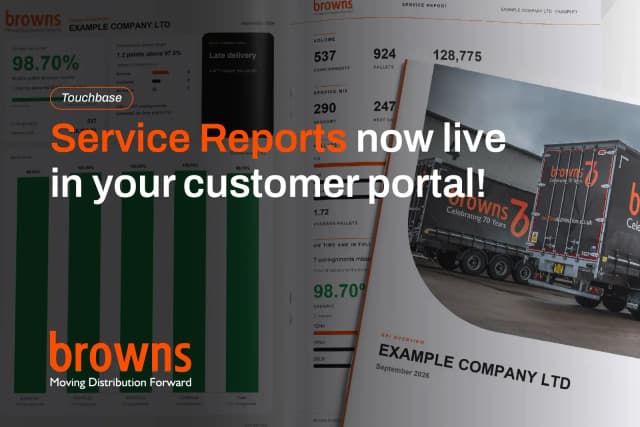
Introducing monthly service reports in Touchbase
Our new monthly service reports are now available in the Browns customer portal, giving you a clearer view of your delivery performance, transport activity and spend. Developed as part of Touchbase, our in-house transport management system, the reports bring together the information you need to