The Role of Technology in Modern Warehousing
Warehousing has changed dramatically over the last decade, and customer expectations have changed even faster.
Whether you’re supplying retailers, manufacturers, e-commerce customers or supporting B2B pallet distribution, the warehouse is no longer just a place to store goods. It has become a critical part of the service engine that drives delivery performance, customer satisfaction, and commercial reliability.
Today, businesses expect faster fulfilment, higher accuracy and real-time visibility across their supply chain. At the same time, warehouse operators are facing labour shortages, rising costs and increasing pressure to do more with less.
This is where warehousing technology plays a key role, not as a “nice to have”, but as a practical tool to improve control, speed, and consistency.
Warehousing isn’t what it used to be
Traditionally, warehousing was viewed as a supporting function: receive stock, store it, pick it, dispatch it.
Now it’s expected to deliver service levels that directly reflect on the brand, including:
- Faster turnaround times and later order cut-offs
- Higher pick and dispatch accuracy
- Live visibility of order status and stock availability
- Proactive exception handling before issues becomes customer complaints
Even in pallet distribution, where B2B supply chains can sometimes be assumed to be less time-sensitive, expectations have moved on. Customers still want goods handled accurately, delivered on time, and supported by reliable tracking and proof of delivery.
Warehousing performance and transport performance are now inseparable, and technology is what connects them.
What warehousing technology looks like today
When people think of warehouse technology, they often picture robotics and automated picking systems. In reality, modern warehousing technology includes a full mix of systems, tools and automation, many of which focus on getting the fundamentals right first.
1. Core systems
At the centre of most operations are the systems that manage the flow of goods and data:
- Warehouse Management System (WMS)
- Transport Management System (TMS)
- ERP integration (so stock and order information stays aligned)
These platforms create structure, reduce reliance on manual admin, and provide the foundation for performance improvement.
2. Data capture and accuracy tools
Accuracy is one of the biggest commercial drivers in warehousing, and it starts with good data capture:
- Barcode scanning
- RFID (where appropriate)
- Mobile devices
These tools reduce manual input and help teams confirm activity at every stage goods in, put-away, picking and dispatch.
3. Automation and equipment
Automation can range from simple process automation to physical automation, including:
- Conveyors and sortation
- Automated pallet wrapping
- AS/RS (automated storage and retrieval systems)
- Goods-to-person systems
The goal is not to replace people, it’s to reduce wasted motion, speed up throughput and protect accuracy.
4. Visibility tools
Visibility is what customers feel most directly. This includes:
- Tracking portals
- Dashboards and KPI reporting
- Exception alerts and proactive notifications
For many customers, the difference between a “good” warehouse service and an “excellent” one is simply knowing what’s happening without having to chase.
The WMS explained: the control centre of the warehouse
A Warehouse Management System is often the single most impactful technology investment a warehouse can make because it creates control.
A well-implemented WMS helps operators:
- Control where stock is stored
- Track inventory in real-time
- Guide pick paths to improve efficiency
- Support FIFO / FEFO stock rotation
- Reduce human error
- Improve auditing and compliance
- Enable reporting and customer visibility
In practical terms, a WMS turns warehousing into a repeatable process rather than a set of workarounds. It makes performance measurable, scalable and less dependent on individual knowledge.
Barcode scanning and mobile technology: accuracy at every touchpoint
Barcode scanning is one of the simplest technologies in warehousing but also one of the most valuable.
When implemented properly, scanning supports:
- Goods-in verification (correct item, correct quantity)
- Put-away accuracy (correct location)
- Picking confirmation (correct item, correct pick)
- Dispatch accuracy (correct goods on the correct vehicle)
This reduces:
- Mis-picks and shortages
- Lost inventory
- Manual admin and paperwork
- Time wasted investigating stock discrepancies
In many operations, scanning and mobile tech provide the quickest return on investment because they remove avoidable errors that cost time, money and customer trust.
Automation: what it really means in warehousing
Automation doesn’t always mean robots.
In many warehouses, the biggest gains come from automating routine tasks and removing unnecessary admin.
Examples include:
- Automated label printing
- Automated documentation
- System triggers based on scan activity
- Automated pallet wrapping
- AI-assisted forecasting and decision support
AI is increasingly being used to analyse operational data, identify patterns, and support better decision-making. For example, AI tools can help predict demand, optimise picking routes, or highlight bottlenecks before they impact performance.
Physical automation, such as conveyors or goods-to-person systems, can deliver huge productivity improvements but only when the operation has the volume and consistency to justify it.
The key is understanding what you’re trying to achieve: speed, accuracy, labour reduction, or improved throughput.
Visibility: the value customers actually feel
Many customers won’t ask what WMS you use but they will notice if your visibility is poor.
Visibility tools give customers confidence and reduce the time spent chasing updates.
This includes:
- Live order status
- Proof of delivery links
- Delivery ETA updates
- Performance dashboards showing OTIF, damages, inventory accuracy and pick accuracy
- Exception alerts when issues occur (missed cut-offs, discrepancies, delays)
Exception management is particularly valuable. It’s better to flag issues early than to let them reach the customer unexpectedly.
When technology helps
Technology works best when:
- Processes are stable and documented
- Data is clean and accurate
- Staff are trained properly
- Reporting is actively used to improve performance
Across the industry, technology projects tend to struggle when:
- It’s layered on top of broken processes
- Onboarding is rushed
- The operation is overly bespoke without documentation
- There is no internal ownership after implementation
In other words, technology supports good operations but it doesn’t replace them.
What to consider before investing in warehouse technology
Before investing in any system or automation, it’s important to identify the real operational constraint.
Start by asking:
What is your current bottleneck?
- Space?
- Speed?
- Accuracy?
- Labour?
What do you actually need?
- Better control of stock?
- Faster processing?
- Better reporting and visibility?
And what will the implementation require?
- Integration with ERP or e-commerce platforms
- Realistic implementation timeline
- Staff training and adoption plan
- Ongoing support and maintenance
The best technology investments are the ones that solve a clear problem, align with the operation’s maturity, and deliver measurable improvements in performance.
Modern warehousing is built on speed, accuracy and transparency, and technology is now essential to achieving all three.
Whether it’s implementing a WMS, improving data capture through scanning, introducing smart automation, or providing customers with real-time visibility, the goal is always the same: deliver a more reliable service and a better customer experience.
At Browns Distribution, we understand that warehousing performance is a key driver of supply chain success, and we continue to focus on practical, proven technology that strengthens control, improves efficiency and supports customer expectations.
If you're looking for a warehousing partner that combines operational expertise with modern technology, learn more about Browns Distribution’s warehousing services.
More from Browns
View all articles
Browns Distribution strengthens warehousing operations with Clarus WMS partnership
We're delighted to announce our partnership with Clarus WMS , marking another major milestone in the continued evolution of Browns Distribution and our investment in technology. The introduction of Clarus at our flagship Distribution House facility in Stoke-on-Trent represents a significant achie
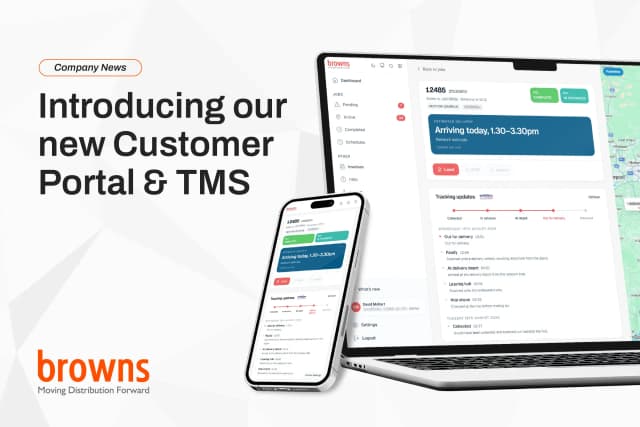
A New Chapter Begins at Browns
Introducing Touchbase, our new Transport Management System Every major investment Browns has made over the past few years has been driven by the same ambition: to make our business stronger, our service better and our customers more successful. That ambition has shaped the way we've investe
Class 1 Drivers Wanted: Join Browns as we Continue to Grow
Browns Distribution is growing, and we’re looking for experienced Class 1 HGV drivers to join us for the journey. New contract wins, continued business growth and the launch of new systems across the operation mean there’s plenty happening at Browns. As our customer base and transport requirements