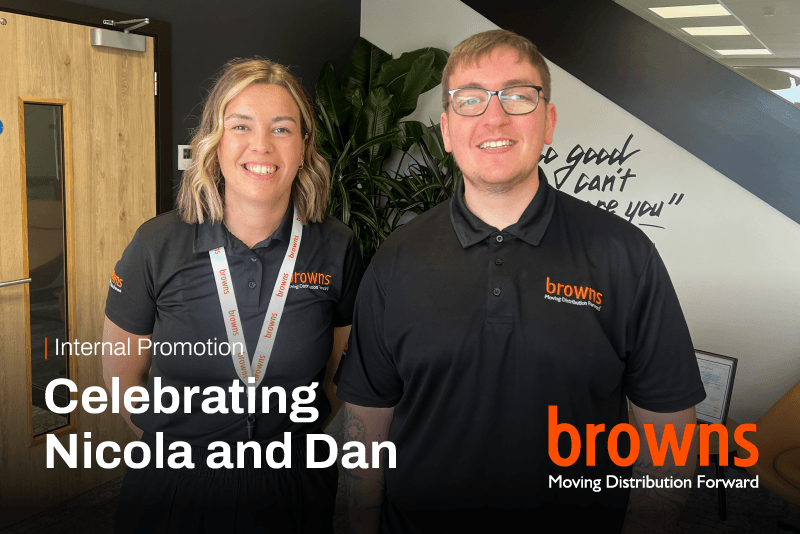
Celebrating Nicola and Dan's Promotions
We are delighted to announce that we're celebrating two promotions within the Browns team. Nicola Ikin and Daniel Penfold have been promoted to Customer Support Manager and Network Freight Manager respectively.
With nearly 15 years of combined experience at Browns, Nicola and Daniel have been key players in their teams, and our journey of growth.
Nicola, who joined Browns in 2014, initially made her mark in the admin team before moving to customer support and steadily climbing the ranks.
Dan began his journey at Browns in 2019 as a Transport Planner in the network freight department. After a brief 7-month departure, he returned to join the general haulage team in 2021.
Kerry Wood, Account Manager said:
Nicola and Dan have shown incredible growth and development and will continue to bring invaluable knowledge and experience to their teams.
We appreciate their willingness to embrace new challenges and are confident in their success in their new roles.
We caught up with Nicola and Dan below to hear about their Browns journey so far, and their experiences in the logistics industry.
Check it out!

Q: Hey Dan, how is everything going? How have you found the transition to the Palletline team from General Haulage?
Everything is good - I'm just getting used to being back on the Palletline team after 3 years away. The transition has been smoother than expected, everyone has been really helpful and supportive in our office and also at Palletline.
Q: What's your main goal/objective for your team over the next 12 months?
I want us to get a Top Liner award from Palletline for hitting our KPIs. That'd be a great confidence boost for the team!
Q: If your work style could be represented by a movie character, who would it be and why?
I would liken my work style to Kung Fu Panda - I started from the bottom, mentored by Mick Stirzaker (Master Shifu) to progress up through the ranks at Browns.
Q: Put yourself in a customer's shoes, what's the most important quality that you'd appreciate from your logistics partner?
I would want complete honesty and proactiveness. There is nothing worse than finding out something which affects you from a 3rd party source. If things are to go wrong, which does happen in transport, I would expect nothing but clarity and we deliver that at Browns through our teams.
Q: We know you are Browns' biggest Stoke fan - What's the one realistic signing you'd like Stoke to make this season?
Realistic? I don't see why Messi wouldn't fancy a crack at the Championship to prove he can do it on a wet and windy night at Stoke! Now back to the real world... A decent striker wouldn't go amiss, someone like Jay Stansfield, Tom Cannon or a cheeky punt for Cameron Archer would be nice.

Admin: It's not for everyone...
Q: In your opinion, what sets Browns apart from other logistics providers in the industry?
Browns is a very unique company. I have worked for other competitors in the area but they do not have the same atmosphere that we have here at Browns. At Browns, there is a constant push for progression whether that be technology wise, with their image or with the staff.
Q: What would you say to someone new to the logistics industry to help them succeed?
The best advice I can give is to always listen to the people around you, be nosey and observe everything that is going on. Also, do not be scared to make decisions, I know it can be daunting but if you make the wrong decision, you will learn for next time and become a lot more confident in all aspects of the job.
Q: Stoke to win the Premier League, or England to win the World Cup?
What a question! It has to be England to win the World Cup, just imagine the scenes.
Q: Looking ahead, where do you see yourself in the future?
I would like to progress in transport and obtain my Transport Manager CPC qualification to further broaden my knowledge of logistics.

Q: Hey Nicola, you're firmly settled into your new role now, how is everything going?
"¯Yes, everything is going fantastic, I'm constantly learning new things within the business to help with my role. Kerry is so suportive and the perfect role model.
Q: You've been at Browns for 10 years now! Can you tell us a bit about your journey so far, from where it all began, to where you are today?
I was recommended by my friend Jade for a role at Browns while I was working as a hairdresser. Despite having no experience in the logistics industry, my thirst for a new challenge led me to join the Admin team!
I worked in Admin for roughly a year until Browns needed to expand the customer service department, and I was offered the opportunity to move into this area. Since then, I have grown in the customer service department, gaining knowledge and experience, and progressing from Team Leader to Supervisor, and now to Manager.
Q: What do you enjoy most about your role?
"¯There are a few things! First would be the team, it's all well and good being a manager, but without a team to lead, the department would not run the way it does. The endless laughs we have are the most important!
And providing the best services possible for our customers, keeping them and their customers happy.
Q: If your customer service skills could be summed up by a song, what would it be?
Ain't no Mountain High Enough "“ Diana Ross! "If you need me call me, no matter where you are, no matter how far"
Admin: Ain't no mountain high, ain't no valley low... What a tune!
Q: Put yourself in a customer's shoes, what's the most important quality that you'd appreciate from your logistics partner?
Honesty and concise communication.
Q: Blue-sky thinking now. What's the craziest thing you'd like to see Browns do in the future? (maybe it's offering an air freight service or opening a depot abroad!)
I would love the business to grow even further and open a new site whether this being in the UK or abroad.
Q: We know you love your live music! What's the best gig you've ever been to, and if you could see any artist (dead or alive), who would it be?
I have been to Benicà ssim festival in Spain, and that was a big job! The biggest artist I have seen would probably be Stevie Wonder!
I would love to have seen Elvis or Queen live.

Q: What advice would you give to someone looking to start a career in logistics?
"¯Have an open mind and make a real effort to learn as much as you can This mindset has really helped me in my time at Browns, especially by being able to approach any problem in an understanding way, from yours and the customer's perspective.
From the office, to the warehouse, to the drivers. There is always room to learn!
Q: What's one thing on your bucket list that you'd love to achieve?
At present, one of the things on the top of my bucket list is to get married in Vegas and get wed by Elvis. (I'm waiting for my partner to pop the question, it's only been 11 years...)
Q: And finally"¦ What's next for Nicola? Where do you see yourself in the next few years?
I want to gain more knowledge and experience in my current role. And then, I'm happy to take on whatever life chucks at me?!
More from Browns
View all articlesPalletline Secures 12th Gold Award for Health and Safety
Originally published by Motor Transport, 21st July 2026. Palletline has won its 12th Gold Award from the Royal Society for the Prevention of Accidents (RoSPA) for its commitment to embedding health and safety into every level of its operation. With one of the lowest accident rates in the industry, Palletline was recognised for its robust workplace management systems and proactive approach to risk management. To secure gold status, the network had to satisfy a demanding set of criteria assessing everything from workforce engagement and safety culture to accident records and health and safety management systems. The company has pioneered a series of industry firsts, including becoming the first pallet network to introduce a 750kg weight limit for standard tail-lift deliveries where a manual pump truck is used – a measure since adopted across the wider transport industry. Innovations such as drive-through warehouses, fully pedestrianised operations, one-way traffic systems and 10mph speed limits have all contributed to the company’s admirable safety record. Carl Moore, group CEO of Palletline, said: “We are delighted to receive this prestigious RoSPA Gold Award once again. “This recognition is a testament to every member of the Palletline team. In an industry where new challenges emerge every day, maintaining the highest standards of health and safety requires constant vigilance, continuous learning and a commitment from everyone across the business. “We will never stand still when it comes to safety,” he added. “We will continue investing in innovation, technology and best practice to build on the standards that have established Palletline as the UK’s leading pallet network for health and safety.” The RoSPA Gold Award marks the second major health and safety accolade for Palletline in recent weeks. The company was also Highly Commended for Safety Excellence at the Safety & Health Excellence Awards.
Route Optimisation: Smarter Logistics for Customers and the Planet
Author: David Mollart, Head of Ecommerce, Browns Distribution Two lorries can leave the same depot carrying exactly the same freight. One makes money. The other loses it. The difference often comes down to decisions made long before the engine starts: how the freight is grouped, the order in which it is loaded, the delivery sequence, the route chosen and whether the vehicle can collect another load on its return. A few planning decisions can separate a productive journey from one that wastes time, fuel and capacity. That is why route optimisation matters. It is often discussed in terms of technology, algorithms and efficiency, but at its heart it is about making better decisions. It means using the information, tools and experience available to plan smarter journeys, make better use of vehicles and deliver a more reliable service for the businesses that depend on us. For Browns Distribution, that is where the real opportunity lies: improving what happens on the road by making better choices before a vehicle leaves the depot. More Than Just the Shortest Route When people think about route planning, they often imagine finding the shortest route from A to B. In reality, the best route is not always the shortest one. A well-optimised route considers a much wider set of factors. It looks at delivery windows, vehicle capacity, driver hours, traffic patterns, fuel efficiency, collection points, onward connections and the type of freight being carried. It also considers how we can make the most of the space available on each vehicle. That last point is particularly important in palletised distribution. A standard articulated trailer will typically carry around 26 UK standard pallets or 33 Euro pallets when single stacked, depending on the load, weight and configuration. But simply filling a trailer is not enough. The real skill is in planning loads so that space, weight and delivery sequence all work together. Two trailers can leave the depot completely full and still perform very differently. One might make 12 deliveries and cover 180 miles. Another could make the same 12 deliveries but travel 250 miles because the freight was loaded in the wrong order or the drops were sequenced poorly. From the outside, the trailers look identical. Operationally, they are not. Good route optimisation prevents that wasted mileage by ensuring the load order, delivery sequence and wider journey work together. Why Vehicle Utilisation Matters One of the most important measures in transport is vehicle utilisation. Put simply, it is about making sure the vehicles we put on the road are being used as efficiently as possible. Every empty space on a trailer represents a missed opportunity. Every unnecessary mile adds cost, fuel usage and emissions. Every poorly planned journey creates avoidable pressure for drivers, traffic teams and customer service teams. Better vehicle utilisation supports lower operating costs, clearer plans for teams and more dependable collections and deliveries for customers. Its effect reaches beyond the transport operation too: when freight arrives as expected, customers are better placed to keep the promises they have made to their own customers. The Environmental Case for Smarter Planning The environmental impact of logistics is rightly under more scrutiny than ever before. As an industry, we have a responsibility to reduce unnecessary mileage, improve fuel efficiency and make smarter choices about how freight moves around the country. Route optimisation has a major role to play in that. The most environmentally friendly mile is often the one we do not need to drive in the first place. By planning more efficient routes, consolidating freight effectively and maximising the use of available vehicle space, we can reduce wasted mileage and make every journey work harder. This is where pallet networks play such an important role. Browns is proud to be part of Palletline , a network built around a multi-hub model that helps reduce the need for freight to travel long distances into one central point. Instead, freight can move through regional hubs, creating a more efficient structure for national pallet distribution. That approach is not just operationally smart; it is environmentally smart too. Palletline’s multi-hub model has been reported to remove millions of trunking miles from the network each year compared with a single-hub model, preventing thousands of tonnes of CO₂ emissions. It is a clear example of how intelligent network design can reduce road miles while still giving customers the national coverage they need. That is what modern logistics should be about: better service, delivered in a more responsible way. Technology’s Growing Role in Transport and Warehousing Technology is becoming increasingly important across every part of logistics, from transport management systems and warehouse management systems to customer booking platforms, tracking tools and electronic proof of delivery. We are also seeing growing use of AI across transport and warehousing. Used properly, AI can help teams analyse large amounts of information quickly, spot patterns, predict demand, identify inefficiencies and support better decision-making. But it is important to be clear about one thing: technology should support people, not replace them. The best logistics operations are not built on technology alone. They are built on experienced teams who understand freight, customers, vehicles, drivers, networks and the realities of the road. Technology gives those teams better visibility and better tools, but the judgement and care of people still matter enormously. At Browns, we want our teams to have the best tools at their disposal. That means investing in systems, processes and ways of working that make life easier for colleagues and improve the service we provide to customers. When our traffic teams have clearer information, they can make better planning decisions. When our warehouse teams have better visibility, they can prepare freight more efficiently. When our customer service teams have accurate updates, they can keep customers informed. And when our drivers are supported with well-planned routes, they can focus on delivering safely, professionally and on time. That is how technology creates value: not as a buzzword, but as something that helps people do great work. Innovation With a Practical Purpose Innovation in logistics does not always have to look dramatic. Sometimes it is a better route plan. Sometimes it is a clearer customer update. Sometimes it is using data to spot where vehicles are underutilised or where a process can be improved. The important thing is that innovation has a practical purpose. At Browns, we have always been focused on moving forward. We are a family-run business with decades of experience, but we also understand that the industry is changing quickly. Customers expect more visibility, more flexibility and more reliability than ever before. At the same time, businesses are under pressure to control costs and improve sustainability. That combination means we cannot stand still. Being innovative in transport is not just about adopting new technology. It is about having the mindset to keep improving. It is about asking better questions. Can we reduce this mileage? Can we plan this route more effectively? Can we give the customer better information? Can we make this process simpler for the team? Can we use this vehicle more efficiently? Those small improvements add up. Over time, they make a real difference to performance, service and environmental impact. What This Means for Customers For customers, route optimisation might not always be visible, but the benefits certainly are. A well-planned journey creates more reliable delivery schedules, clearer communication and fewer last-minute changes. Poor planning can have the opposite effect: a delivery window is missed, the next drop is delayed and one inefficient decision begins to affect several customers. Route optimisation helps contain that risk while keeping costs under control and supporting sustainability goals through reduced mileage and better vehicle efficiency. For ecommerce customers in particular, this matters more than ever. When a business sells online, the delivery experience becomes part of the customer experience. A late, missed or poorly communicated delivery can affect reputation, reviews and repeat business. That is why we look at logistics as more than moving freight. We are helping our customers keep their promises. Whether we are moving a single pallet, managing regular distribution or supporting a wider ecommerce operation, route optimisation helps us provide a service that is dependable, efficient and built around real-world customer needs. Smarter Routes, Stronger Service The future of logistics will be shaped by businesses that can combine experience, technology and responsibility, but the value of route optimisation is already visible in the decisions made every day. Route optimisation affects far more than mileage. It influences cost, reliability, workload, customer service and environmental performance. The difference between a profitable route and a wasteful one may be a loading decision, a delivery sequence, an avoidable detour or an empty return journey. None of those choices looks dramatic in isolation, but together they determine how well a transport operation performs. For Browns Distribution, smarter route planning is not simply about finding a quicker way from A to B. It is about making each vehicle, journey and decision work harder for our teams, our customers and the wider environment. That means continuing to combine practical experience with better information and technology, so that we can reduce waste, support reliable service and help customers keep their own promises. For customers, the value lies in working with a logistics partner that treats every route as an opportunity to improve reliability, efficiency and environmental performance. Every mile matters. The challenge is not simply driving fewer miles. It is making every mile count.
A Guide to Outsourcing Your Logistics Successfully
Outsourcing logistics is no longer something only large organisations consider. In today’s fast-moving supply chain environment, more businesses are turning to specialist partners to improve service levels, control costs, and gain the flexibility needed to grow. But outsourcing successfully isn’t just about moving pallets from A to B. It’s about choosing the right partner, setting expectations early, and building a relationship that supports your wider business goals. In this guide, we’ll explore why outsourcing is growing, what it means, the benefits and risks, and how to make the transition smoothly. Why logistics outsourcing is growing The logistics landscape has shifted significantly, with businesses under increasing pressure to deliver reliable and cost-effective service. Key drivers include: Rising customer expectations Customers now expect fast delivery, accurate tracking, and flexible options as standard. Delays or lack of visibility can quickly impact satisfaction and repeat business. Driver shortages and labour pressures Ongoing challenges around driver availability and warehouse staffing are making in-house operations harder to sustain. Warehouse space and cost challenges Warehouse space is increasingly expensive and difficult to secure, especially in key UK regions, making expansion costly and slow. Ecommerce growth and rising returns Ecommerce has added complexity, particularly around fulfilment speed and returns, which can be unpredictable and resource-heavy. The need for peak-time flexibility Seasonal demand and promotions can quickly overwhelm internal operations. Outsourcing provides scalable capacity without long-term investment. What outsourcing logistics actually means Outsourcing can look different depending on your business needs. Most commonly, it includes: Transport and distribution Warehousing and storage Fulfilment (pick, pack, dispatch) Returns management Value-added services (labelling, kitting, repacking) 2PL vs 3PL: what’s the difference? 2PL (Second Party Logistics): Focused on transport only 3PL (Third Party Logistics): A broader solution including warehousing, fulfilment, and systems For many growing businesses, 3PL offers greater flexibility and visibility. Signs you’re ready to outsource Outsourcing isn’t always the right step early on, but there are clear indicators it may be time. You may be ready if: Your warehouse is at or near capacity Delivery issues are affecting customer experience Costs per order or pallet are rising You can’t scale quickly to meet demand Your team is focused on logistics over growth You lack tracking, reporting, or visibility Returns are becoming difficult to manage If several of these apply, outsourcing can help create stability and free up internal resource. The benefits of outsourcing logistics A strong logistics partnership delivers more than operational support, it strengthens service and supports growth. 1. Scalability and peak management Capacity can flex in line with demand, particularly during seasonal peaks. 2. Improved service levels and reliability Established processes and networks help improve delivery performance and reduce disruption. 3. Stronger systems and reporting Outsourcing often provides access to: Real-time tracking Inventory visibility Performance reporting KPI dashboards 4. Reduced operational risk Risk is spread across larger infrastructure, reducing reliance on limited internal resources. 5. Access to wider distribution networks Providers offer established UK networks that are costly to build independently. 6. Focus on core business Internal teams can prioritise sales, customer experience, and growth instead of day-to-day logistics. Common outsourcing mistakes Outsourcing can be highly effective, but only when approached correctly. Choosing a provider based on price alone Lower cost can lead to poor service or hidden charges. Focus on value and capability. Unclear service expectations Lack of clarity can cause misalignment. Define responsibilities and service levels early. Poor onboarding or rushed transition Rushed implementation can lead to delays and stock issues. Plan properly. Underestimating systems integration Without proper integration, visibility suffers and errors increase. Not agreeing KPIs early KPIs provide structure and accountability, define them from day one. Lack of communication structure Without regular communication, small issues can escalate. How to choose the right logistics partner A successful partnership depends on fit, not just service offering. Consider: Sector experience (e.g. retail, ecommerce, FMCG) Service levels and coverage Network capability Flexibility to scale Compliance and accreditations Systems and visibility Culture and communication The best partners operate as an extension of your team. What successful onboarding looks like A structured onboarding process is key to a smooth transition. This should include: Discovery and data gathering Understanding volumes, products, requirements, and pain points. Site visits and process mapping Ensuring the solution is practical and efficient. Cutover planning Defining timelines, stock transfer, systems, and responsibilities. Contingency planning Preparing for potential issues to minimise disruption. Stakeholder responsibilities Clear ownership on both sides. The data you need to provide before outsourcing Accurate data is essential to building the right solution. This typically includes: Shipment profile (pallets, parcels, mixed loads) Delivery locations and frequency Peak volumes and seasonal trends SKU profile and handling requirements Returns profile and volumes Service level requirements Current pain points Better data leads to smoother onboarding and more accurate pricing. Communication and governance: keeping the partnership working Outsourcing works best as a partnership, not just a service contract. A strong structure includes: Weekly operational calls Monthly KPI reviews Quarterly business reviews Clear escalation routes Continuous improvement processes Regular communication keeps both sides aligned and proactive. Outsourcing done well is a growth strategy Outsourcing logistics isn’t about losing control, it’s about gaining capability, flexibility, and resilience. With the right partner, clear expectations, and a structured approach, it becomes a strategic advantage: improving service, reducing risk, and giving your business room to grow. If you're exploring a more scalable, reliable approach to logistics, our contract logistics services are designed to support growing businesses with flexible warehousing, distribution, and fulfilment solutions. Get in touch with our team to discuss your requirements and see how we can support your operation.